A Night at Naka Market
- Bambi

- Jul 8, 2025
- 3 min read
Updated: Aug 11, 2025

Historically Phuket has represented an important trade centre of the Andaman sea, attracting merchants from a variety of far reaching destinations. Over the course of centuries, with the influence of immigrants and tourism, Phuket’s night markets have become what they are today. Phuket’s markets are not only a place to experience Thailand through taste, sound, smells and sights, but are community hubs and trade centers which remain an important part of Thai culture1.
The Naka Market, located in the Mueang Phuket District, was on the top of our list of markets to visit. It has over 48 food and drink stalls available during the week, expanding to over 200 during the Naka Weekend Market. Not to mention the hundreds of other, non-meal related stalls. As lovers of food, and eager to try some traditional dishes, we ventured there on a Saturday night.

As a pescatarian, I focussed on all things seafood at the market, whilst Tom explored the meatier options. We found a massive range of foods available, with a huge mix of cultural influences. After a few passes up and down the crowded and stall-packed rows we started sampling the things that caught our eyes most.
As lovers of Japanese cuisine it was hard to walk past the Takoyaki stall boasting a range of different flavours; we tried both the prawn and crab options which were delicious. Similarly, the sushi stalls with their rows of beautifully decorated, and oddly flavoured, individual sushi (at only around 10 Thai Baht each) drew us in to explore a few different types. Of note “cheese” sushi is more tasty than it sounds.
There were a range of much more traditional Thai dishes, which ended up being our favourite of the night. BBQ skewers became popular in the 1950’s alongside the rise in street cart vendors2. Tom sampled sticky chicken and pineapple skewers (Gai Yang) from one stall, and a set of seven beef (Nuea Yang) from the other (after convincing the stall-owner that he would in fact be able to handle the chilli sauce).


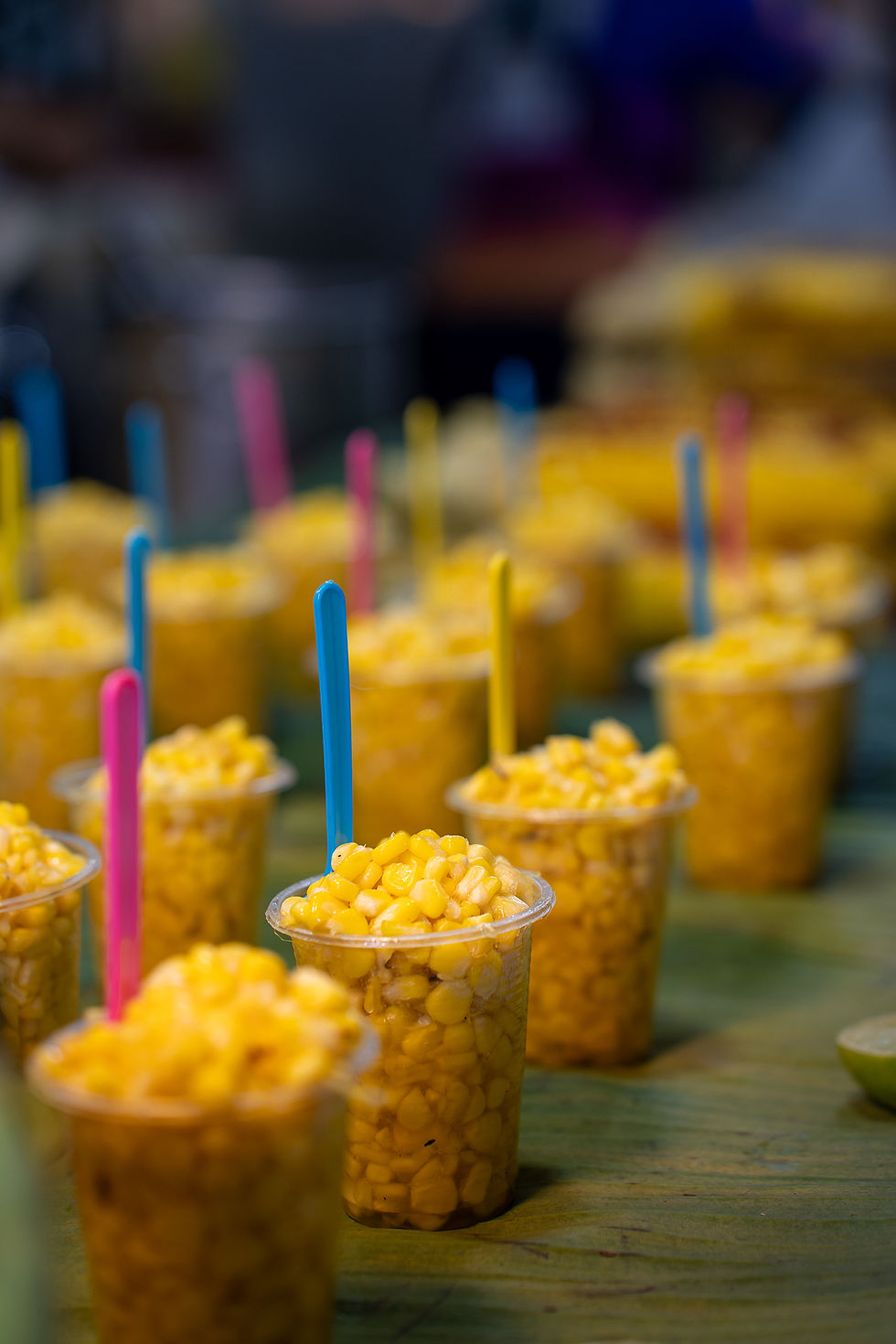
We fell for what appeared to be a skewer of prawns, cooked over a charcoal hotplate, but turned out to be prawn shaped seafood stick (crab stick). Boiled corn is always a winner for me, although I did not miss the fact that we were again protected from spice, when the stall owner minimally seasoned a plain corn with chilli powder, rather than handing me the pre-prepared chilli corn I had pointed at. Although not too spicy, this was probably for my own good.

My highlight of the night was Kanom Beung (Thai crispy pancakes), a small crispy pancake, folded in a taco shape and filled with golden thread (egg) or desiccated coconut (we tried both). These were prepared in front of us by a Thai woman at an ancient looking stall covered in photos of her (young to old) alongside a range of celebrities.
After Tom anxiously indicated that we would return each time we passed a man selling tiny moist coconut pancakes, we fulfilled his promise on our dessert lap.

As he cooked, the stall owner explained that the clay devices on display are the traditional cooking method. He chuckled that they are too slow to be used at the market; hence the large metal plate pocked with golf ball sized half-spheres which he filled with batter before joining two halves in a small ball.
Lastly we sampled mango sticky rice (Khao Niew Mamuang), a Thai staple we had seen on almost every menu. Of all the mango sticky rice we tried in Phuket, and we tried a few, this one took the crown. The friendly stall owner cheerfully explained how to pour the sweet coconut sauce, and encouraged us to try the crispy mung beans sprinkled on top. She then excitedly gave us extra sauce and mung beans when we could not answer whether we liked it or not, having never tried it before. The mango was sweet and juicy, the rice sticky, and the mung beans crunchy and adding diversity to the textures.
With multiple trips back and forth to the seating sections where we watched bands and singers entertain the crowd, we ended up sampling 12 different dishes. Ranging from only 20 Thai Baht ($1 AUD) to 100 Thai Baht ($5 AUD) it was easy to sample to our hearts content. Our total bill came to only 660 Thai Baht (around $33 AUD). The Naka Market was a highlight of Phuket for us. Extremely budget friendly, entertaining and some of the best food we had.
Comments